
There’s a moment, just before dawn, when you’re standing on the edge of a volcanic crater surrounded by an alien landscape of grey ash and towering peaks, and you realize: I did this entirely on my own. No tour bus, no guide holding a flag, no rigid schedule. Just me, a motorbike, and one of the most spectacular volcanic landscapes on Earth.
Visiting Mount Bromo without a tour was one of the most rewarding travel experiences I’ve had in Indonesia. It saved me money, gave me complete freedom, and honestly made the whole adventure feel more real. If you’re considering doing it independently, here’s everything you need to know.
Why Skip the Tour?
Let me start with the obvious question: why go independent when dozens of agencies in Probolinggo, Surabaya, and even Bali will happily organize everything for you?
Three reasons. First, cost. Organized tours from Surabaya typically charge IDR 600,000-1,200,000 ($40-80 USD) per person. I spent roughly IDR 250,000-300,000 ($17-20 USD) total doing everything myself, including transport, entrance fees, and accommodation. That’s a massive saving, especially for budget travelers.
Second, freedom. Tour groups follow a strict schedule: sunrise viewpoint at 4 AM, crater at 6 AM, done by 8 AM. Going independently, I could linger at the viewpoint as long as I wanted, walk the Sea of Sand at my own pace, and even go back for sunset (which almost nobody does, and it’s gorgeous).
Third, the experience. There’s something deeply satisfying about navigating your own way through the volcanic landscape. It transforms the visit from a passive sightseeing trip into a genuine adventure.
Getting to Cemoro Lawang
Cemoro Lawang is the tiny village perched right on the rim of the Tengger caldera, and it’s your base for exploring Bromo. Here’s how to get there.
From Surabaya
Take a train or bus to Probolinggo (about 2-3 hours). From Probolinggo’s bus terminal, minivans run to Cemoro Lawang for around IDR 50,000-75,000 per person. The ride takes about 1.5 hours up winding mountain roads. The last minivans usually leave around 3-4 PM, so don’t arrive in Probolinggo too late.
From Malang
You can also approach from Malang via Tumpang. Shared jeeps run from Tumpang market to Cemoro Lawang, though this route is less frequent. Allow about 2.5 hours.
From Yogyakarta or Bali
Take an overnight train or bus to Probolinggo, then continue as above. Many travelers combine Bromo with Ijen crater, doing Bromo first and then heading east.
Where to Stay in Cemoro Lawang
Cemoro Lawang is small but has plenty of guesthouses and homestays. I stayed at a simple but clean guesthouse for about IDR 150,000-200,000 ($10-13 USD) per night. The rooms are basic – don’t expect luxury – but you’re here for the volcano, not the thread count.
My tip: Book a room with a view of the caldera if you can. Waking up and seeing the volcanic landscape from your window is an incredible way to start the day. Some popular options include Cafe Lava Hostel and Hotel Bromo Permai, but there are many budget guesthouses along the main road.
One important note: it gets cold at night. Cemoro Lawang sits at about 2,200 meters elevation, and temperatures drop to 5-10°C (41-50°F) after dark. Most guesthouses provide blankets, but bring a warm layer just in case.
The Sunrise: King Kong Hill or Penanjakan?
The sunrise over Bromo is the main event, and you have two main viewpoint options.
Penanjakan (Mount Pananjakan)
This is the classic, most popular viewpoint at 2,770 meters. It offers a jaw-dropping panorama of the entire Tengger caldera with Mount Bromo, Mount Batok, and Mount Semeru (Java’s highest peak) all lined up. The downside? Tour groups flood this spot. If you want to go independently, you can hire a jeep from Cemoro Lawang (IDR 300,000-450,000 for the whole jeep, split between passengers) or attempt the steep hike in the dark (not recommended unless you know the trail well).
King Kong Hill
This is my recommendation for independent travelers. King Kong Hill is a closer, easier-to-reach viewpoint that you can walk to from Cemoro Lawang in about 30-45 minutes. The view is slightly different but equally spectacular – some argue even better because you’re closer to the action. Best of all, it’s far less crowded than Penanjakan, and you don’t need to hire any transport.
To reach King Kong Hill, walk along the caldera rim from Cemoro Lawang heading left (when facing the caldera). Follow the trail – locals can point you in the right direction. Bring a headlamp because you’ll be walking in complete darkness.
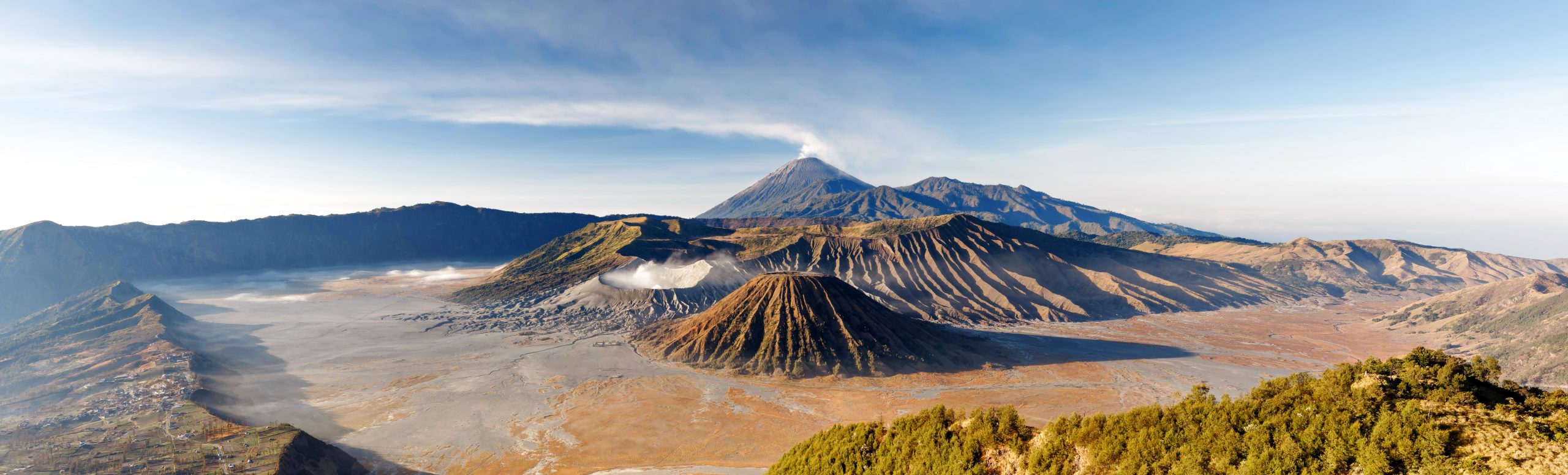
The breathtaking panorama: Mount Bromo (smoking crater), Mount Batok (the textured cone), and Mount Semeru (tallest peak in the background). Photo: Edwind Chayono Kusuma, CC BY-SA 4.0, via Wikimedia Commons.
The Timeline: What Time to Wake Up
Here’s the schedule I followed, and I’d recommend the same:
- 3:30 AM – Wake up. Yes, it hurts. Layer up warmly.
- 4:00 AM – Start walking to King Kong Hill. Headlamp on, follow the trail along the rim.
- 4:30-4:45 AM – Arrive at the viewpoint. Find a good spot and wait.
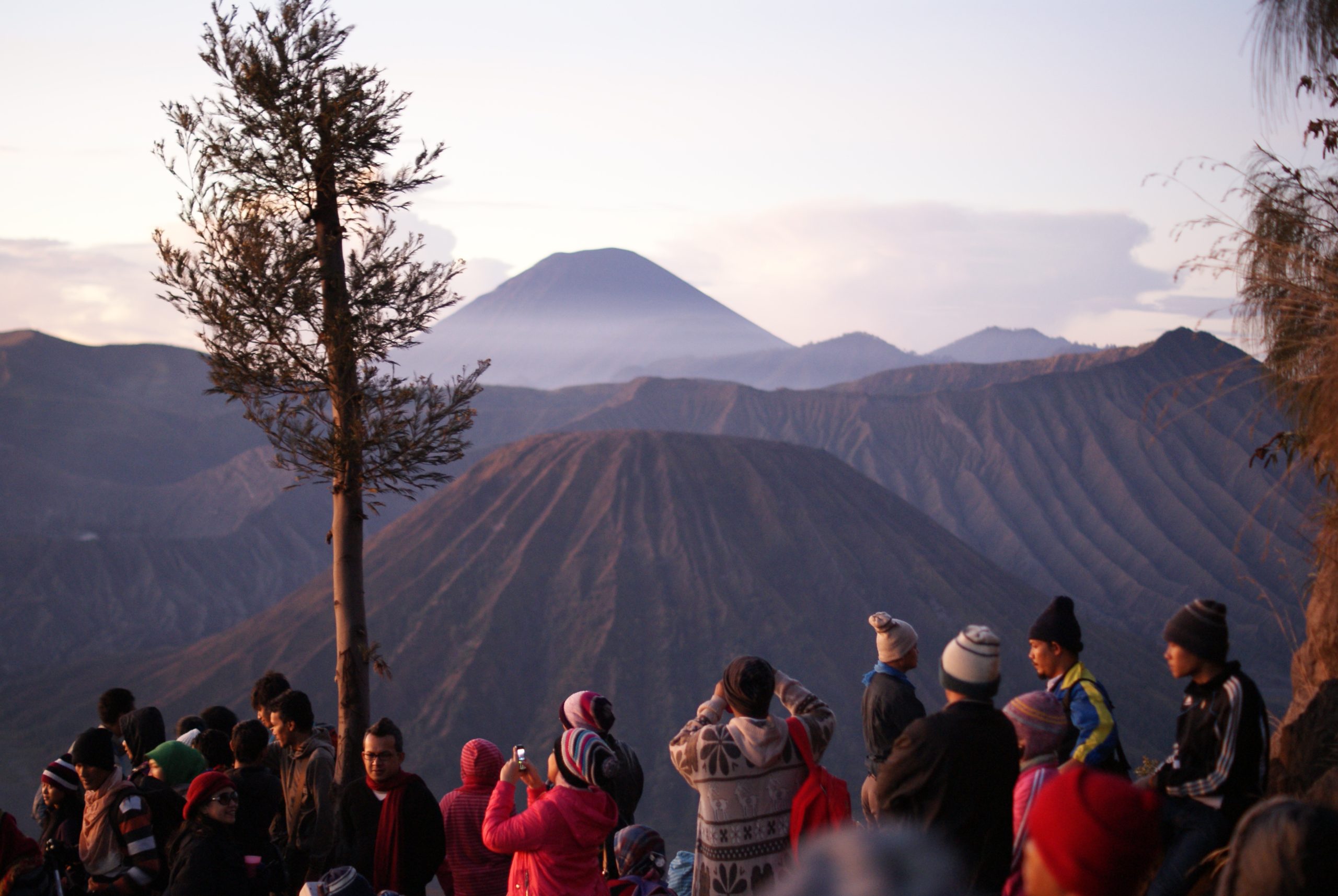
- 5:15-5:45 AM – Sunrise. The sky shifts from deep purple to orange to gold. Mount Semeru might puff out a cloud of volcanic smoke. It’s absolutely magical.
- 6:00-6:30 AM – Head back toward Cemoro Lawang and descend into the caldera.
- 7:00-8:30 AM – Cross the Sea of Sand and climb Mount Bromo’s crater.
- 9:00 AM – Back in Cemoro Lawang for a well-earned breakfast.
Crossing the Sea of Sand
After sunrise, the real adventure begins. From Cemoro Lawang, a concrete staircase descends steeply into the Tengger caldera. At the bottom, you step onto the Sea of Sand (Segara Wedi) – a vast, flat expanse of volcanic ash that looks like the surface of the moon.
The walk across the Sea of Sand to Mount Bromo’s base takes about 30-45 minutes. It’s flat and straightforward, though the soft ash can make it slow going. You’ll see the smoking crater of Bromo ahead and the perfectly symmetrical cone of Mount Batok beside it.
Locals offer horseback rides across the sand for around IDR 100,000-150,000, but honestly, the walk is half the experience. The silence, the vast emptiness, the volcanic landscape stretching in every direction – it’s otherworldly.
Climbing to the Crater
At the base of Mount Bromo, a steep staircase of about 250 steps leads up to the crater rim. It takes 15-20 minutes and can be tiring at altitude, but the reward is extraordinary. Standing on the rim, you look directly down into the active crater. Steam and sulphurous gas billow up from the depths. The roar of the volcanic vents is both thrilling and humbling.
Walk around the rim (carefully – there are railings in most places but not everywhere) for different perspectives. On a clear morning, you can see Mount Semeru smoking in the distance.
Safety note: Stay behind the railings. The crater walls are loose and crumbly. People have fallen in. Don’t be reckless for a photo.
Entrance Fees and Costs
Here’s a breakdown of what I spent as an independent traveler:
- Bromo Tengger Semeru National Park entrance fee: IDR 220,000 for foreign tourists on weekdays, IDR 320,000 on weekends/holidays (as of 2024/2025 – check for updates)
- Minivan Probolinggo to Cemoro Lawang: IDR 50,000-75,000
- Accommodation: IDR 150,000-200,000 per night
- Food: IDR 30,000-50,000 per meal at local warungs
- Total for the independent trip: roughly IDR 500,000-700,000 ($33-47 USD)
Compare that to organized tours at IDR 600,000-1,200,000+ per person, and the savings are clear – especially if you’re traveling with a partner and can split transport costs.
What to Wear and Bring
Bromo is cold, dusty, and high altitude. Here’s what you need:
- Warm layers: Thermal base layer, fleece, and a windproof jacket. At 3:30 AM at 2,200+ meters, it’s genuinely cold.
- Headlamp or flashlight: Essential for the pre-dawn walk to the viewpoint.
- Scarf or buff: To cover your nose and mouth. The volcanic ash and sulphur fumes at the crater are intense.
- Sturdy shoes: Closed-toe shoes with decent grip. You’ll be walking on volcanic ash, climbing stairs, and navigating uneven terrain.
- Water and snacks: Bring at least one liter. There are vendors near the crater but prices are inflated.
- Camera: Obviously. But also bring a plastic bag to protect it from volcanic ash – the fine dust gets everywhere.
- Sunscreen and sunglasses: Once the sun comes up, the reflection off the Sea of Sand is blinding.
Is It Worth Doing Bromo Without a Tour?
Absolutely, without hesitation. Visiting Mount Bromo independently is straightforward, significantly cheaper, and infinitely more rewarding. The infrastructure in Cemoro Lawang is set up for independent travelers – there’s no language barrier you can’t overcome with a smile and Google Translate, the trails are well-worn, and the locals are friendly and helpful.
Standing on that crater rim, breathing in the sulphurous air, watching the sun paint the volcanic landscape in shades of gold, I felt the kind of raw, unfiltered awe that only comes from earning the experience yourself. No tour guide could have made that moment any better.
If you’re in East Java, do yourself a favor: skip the tour, catch a minivan to Cemoro Lawang, set your alarm for an ungodly hour, and go meet Mount Bromo on your own terms. You won’t regret it.
Featured image: 22Kartika, CC BY-SA 3.0, via Wikimedia Commons.