There are days that change you. Days that strip away everything comfortable and familiar, and leave you standing raw and breathless at the edge of what you thought was possible. Day 10 of the Annapurna Circuit — the crossing of Thorong La Pass at 5,416 meters — was that day for me.
I knew it would be hard. Every trekker on the trail had been talking about it for days: the altitude, the cold, the grueling climb. But nothing anyone said could have truly prepared me for what it felt like to drag myself up that mountain in the dark, fighting for every breath, wondering more than once whether I had made a terrible mistake.
This is the story of crossing the highest point of the Annapurna Circuit, from Thorong Phedi to Muktinath, and everything you need to know if you are about to do it yourself.
The 3 AM Wake-Up Call
My alarm went off at 3:00 AM in the freezing tea house at Thorong Phedi (4,450m). I had barely slept. Between the altitude headache, the bitter cold seeping through my sleeping bag, and the anxiety about what lay ahead, I might have managed two hours of restless dozing at best.
The tea house was already buzzing with nervous energy. Headlamps flickered in the dining room as trekkers bundled into every layer they owned, shoveling down porridge and hot tea. Nobody spoke much. The mood was a mix of determination and quiet dread. We all knew what the next eight hours would demand.
I forced down a bowl of oatmeal and two cups of sweet black tea, filled my water bottles with warm water (critical — your water will freeze otherwise), and stepped out into the darkness at 3:45 AM. The stars were absolutely staggering. Thousands of them, impossibly bright at this altitude, scattered across a sky so clear it almost didn’t look real. For a brief moment, I forgot about the cold and the fear and just stared upward. Then I started walking.
The Climb to High Camp
The first stretch from Thorong Phedi (4,450m) to High Camp (4,850m) took about an hour. The trail climbed steeply through rocky terrain, and within fifteen minutes I was already gasping. At this altitude, your body is working with roughly half the oxygen it gets at sea level. Every step felt like running while breathing through a straw.
I fell into a rhythm: ten steps, pause, breathe. Ten steps, pause, breathe. My headlamp illuminated a narrow cone of rocky trail, and I could see the bobbing lights of other trekkers both ahead and behind, a silent procession of determined souls crawling upward in the dark.
At High Camp, some trekkers who had stayed the night there joined our procession. Smart move, honestly — sleeping at 4,850m instead of 4,450m gives you a slight advantage for summit day, though the tea houses there are more basic and the extra altitude can make sleep even harder.
The Push to Thorong La Pass (5,416m)
Above High Camp, the real battle began. The trail became a relentless zigzag up a vast, barren mountainside. There were no trees, no vegetation — just rock, ice, and the occasional frozen stream crossing. The wind picked up savagely. Even with four layers on top and thermal leggings under my trekking pants, the cold cut straight through.
This is where altitude sickness becomes a genuine danger. At 5,000 meters and above, your body is in survival mode. I felt a persistent dull headache, mild nausea, and an overwhelming fatigue that made every step feel like wading through wet concrete. Two trekkers I had been walking with for days turned back at around 5,100m — one was vomiting, the other could barely stand upright. There is absolutely no shame in turning back. Altitude sickness can kill, and the mountain will always be there for another attempt.
The last 300 meters of elevation gain were the hardest physical thing I have ever done. I was taking three or four steps at a time before stopping to lean on my trekking poles and gasp for air. My pace slowed to a crawl. Time lost all meaning. I stopped checking my watch and just focused on the next step, then the next one, then the next.
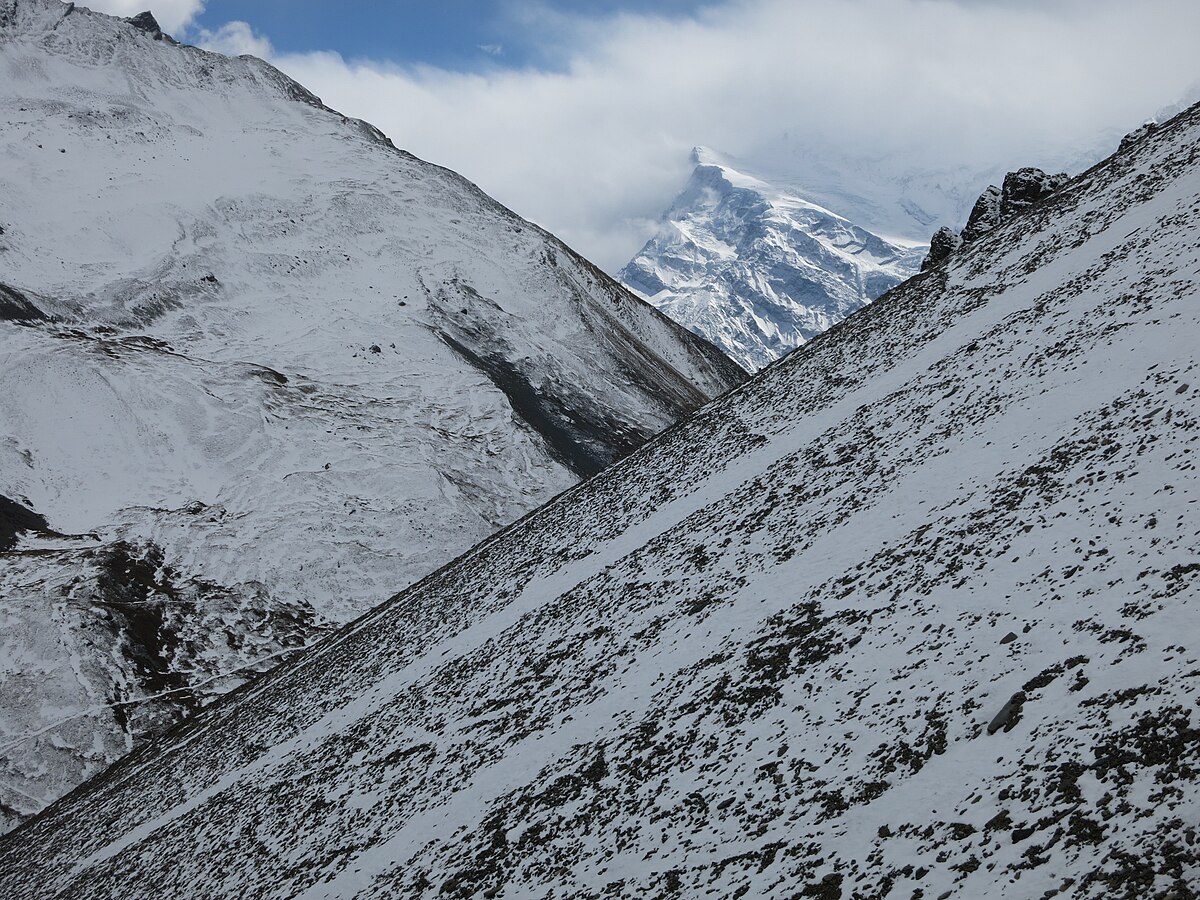
Photo: Thorong La Pass (5,416m), the highest point of the Annapurna Circuit. Credit: Vaupk12, CC BY-SA 4.0, via Wikimedia Commons.
And then, suddenly, I saw them: prayer flags. Hundreds of them, strung between poles, snapping violently in the wind against a backdrop of blinding white peaks and impossibly blue sky. The sign read: Thorong La — 5,416m.
I had made it.
I am not ashamed to say that I cried. Standing at the highest point I had ever reached in my life, surrounded by the most dramatic mountain scenery on Earth, after hours of pushing my body beyond what I thought it could handle — the emotion just poured out. I looked around and I was not the only one. Grown adults sobbing, hugging strangers, laughing and crying at the same time. It was one of the most beautiful, most human moments I have ever experienced.
The Descent to Muktinath (3,800m)
You cannot stay long at the pass. The altitude is dangerous, the wind is brutal, and your body is burning through energy at an alarming rate. After twenty minutes of photos, celebration, and trying to catch my breath, I started the descent toward Muktinath.
If the climb was a slow-motion battle of willpower, the descent was a fast and furious assault on my knees. You drop over 1,600 meters in roughly 4-5 hours, and the trail is steep, loose, and unforgiving. My trekking poles saved my knees on this stretch — I genuinely do not know how people do it without them.
But here is the magical thing: with every hundred meters of descent, the world came back to life. The air grew thicker and richer. My headache vanished. Colors seemed brighter. Scrubby bushes appeared, then actual plants, then the first signs of the Mustang region’s extraordinary arid landscape — red and ochre cliffs, wide valleys, and in the distance, the dusty town of Muktinath.
I arrived at my tea house in Muktinath at around 1:00 PM, completely shattered but buzzing with an overwhelming sense of accomplishment. A hot dal bhat, a cold beer, and a long nap — in that order — restored me to something resembling a functioning human being.
Practical Information: Thorong Phedi to Muktinath
Key Numbers
- Distance: Approximately 16-18 km
- Elevation gain: ~966m (Thorong Phedi at 4,450m to Thorong La Pass at 5,416m)
- Elevation loss: ~1,616m (Thorong La Pass at 5,416m to Muktinath at 3,800m)
- Total time: 8-12 hours depending on fitness and conditions
- Ascent time: 4-6 hours from Thorong Phedi to the pass
- Descent time: 3-5 hours from the pass to Muktinath
What to Pack for Pass Day
This is the one day on the Annapurna Circuit where your packing really matters. Here is exactly what I wore and carried:
- Clothing: Thermal base layer (top and bottom), fleece mid-layer, down jacket, waterproof/windproof outer shell, warm hat covering ears, neck gaiter or balaclava, two pairs of gloves (liner gloves plus insulated outer gloves), warm trekking socks
- Gear: Trekking poles (absolutely essential for both the climb and especially the descent), headlamp with fresh batteries, sunglasses with UV protection (the snow glare is blinding), sunscreen SPF 50+
- Food & water: At least 2 liters of water (fill with warm water so it does not freeze), energy bars, chocolate, dried fruit, glucose tablets
- Medicine: Diamox (acetazolamide) if you have been using it for acclimatization, ibuprofen for altitude headache, any personal medications
Tea Houses and Stops
- Thorong Phedi (4,450m): Your starting point. Basic but adequate tea houses. Last proper meal before the pass.
- High Camp (4,850m): A cluster of very basic tea houses about one hour above Thorong Phedi. Some trekkers stay here the night before to reduce summit day elevation gain. Limited amenities.
- Thorong La Pass (5,416m): A small tea shop at the top sells overpriced hot drinks and snacks. Worth every rupee for a cup of sweet tea at the roof of the world.
- Charabu (4,230m): A small rest stop on the descent where you can get tea and snacks.
- Muktinath (3,800m): A proper town with decent tea houses, hot showers (heaven after this day), restaurants, and the famous Muktinath Temple.
Essential Tips
- Start early. Leave by 3:30-4:00 AM at the latest. You want to cross the pass before afternoon winds and potential weather changes make conditions dangerous.
- Acclimatize properly. Do not attempt the pass if you have any symptoms of serious altitude sickness (severe headache, confusion, loss of coordination, persistent vomiting). Descend immediately if these occur.
- Go slow. This is not a race. The trekkers who rush are the ones who get sick. Walk at a pace where you can still breathe through your nose.
- Eat and drink constantly. Your body is burning enormous amounts of energy at this altitude. Sip water every few minutes and nibble on snacks throughout the climb.
- Trekking poles are non-negotiable. The descent to Muktinath is steep and loose. Your knees will thank you.
- Watch for weather. If there has been heavy snowfall, the pass may be closed. Always check conditions with your tea house owner and other trekkers the evening before.
- Hire a porter or guide if you are unsure. There is no shame in having support on the hardest day. A good guide can make the difference between a safe crossing and a dangerous one.
Was It Worth It?
Absolutely. Without question. Crossing Thorong La Pass was the single most challenging and rewarding experience of my entire time on the Annapurna Circuit. The physical suffering was real, but the sense of achievement, the raw beauty of the high Himalayas, and the emotional intensity of pushing past your limits — these are things that stay with you forever.
Standing at 5,416 meters with prayer flags whipping around me and the entire Annapurna range spread out in every direction, I understood why people trek for weeks through remote Nepalese mountains to reach this point. It is not about conquering anything. It is about discovering what you are capable of when the trail gets steep, the air gets thin, and the only way forward is one more step.
If you are planning the Annapurna Circuit, do not fear Day 10 — respect it. Prepare for it. And when you finally see those prayer flags at the top, let yourself feel every bit of the emotion. You will have earned it.